Research Article | | Peer-Reviewed

Improved Forage as Supplemental Feed Source and Its Utilization System in Yem Special Woreda of Central Ethiopia

Received: 1 January 2025     Accepted: 10 March 2025     Published: 29 April 2025
Views:       Downloads:
Abstract

This study was conducted to assess the improved forage production and Utilization. For this study, three kebeles were selected purposively based on their livestock potential and 160 households were selected from selected kebeles randomly. The major feed resource in the study area was crop residue and pasture land grazing. The dominant forage species adopted in the area were Desho and elephant grass. Primary problem for livestock production was the shortage of feed resources. Majority (66%) of the households were in the active productive age (31-45) about 60% of household heads were literate (primary school and above). The average land cultivated per household in the study area was 0.25 hectares. Crop production was the principal source of cash income in the region, followed by cattle production in second place and sheep production in third. Almost all households in the study area had experience in cultivating improved forage, particularly elephant and desho grasses. The main challenges related to livestock production identified in the area were primarily diseases, ranked first, followed by feed shortages in second place, and water shortages in third, along with issues related to poor breed performance to some extent. Among the main feed sources identified, grazing, crop residues, and desho grass were ranked first, second, and third, respectively, in the study area.

Published in International Journal of Statistical Distributions and Applications (Volume 11, Issue 2)
DOI 10.11648/j.ijsda.20251102.11
Page(s) 20-27
Creative Commons

This is an Open Access article, distributed under the terms of the Creative Commons Attribution 4.0 International License (http://creativecommons.org/licenses/by/4.0/), which permits unrestricted use, distribution and reproduction in any medium or format, provided the original work is properly cited.

Copyright

Copyright © The Author(s), 2025. Published by Science Publishing Group

Keywords

Crop Residue, Desho Grass, Forage Crop, Yam Special Woreda

1. Introduction
Livestock population of south nation national people region state (SNNPR) estimated to 12,404,963 cattle, 4,735,604 sheep, 4,819,573 goats, 292,496 horses 305,089 dockey, 7,0365 mules, and 7,347,205 poetry . Despite the large livestock population in the country with high potential for meat and milk production, the contribution of the sector is well below its biological potential due to various reasons. Feed Shortage and disease, fewer effects in introducing the appropriate improved livestock technologies, cross breeds, improved feeds management practices is indicated as a factor resulting for lower production, productivity growth performance and reproductive of animal especially during the dry period .
During dry season, in adequacy of grazing resources result for animals not to meet even their maintenance requirements and body weight losses. Livestock feed resources are classified as natural pasture, crop residue, improved pasture, forage, agro industrial by product and other by products like food and vegetable refusal, with the first two contribute the largest feed type Animal depends mainly on natural pasture for their feed requirements. However, natural pastures which provide more than 90% are very poorly managed.
The important of natural pasture is gradually declining and expansion of crop production in to grazing lands also redistribution of common lands to the landless and land degradation . Though increased utilization of agro-industrial products has been reported, they are not available, affordable or feasible for most of the small holder farmers in Ethiopia. Hence, animals are allowed to graze natural pasture or crop stubbles around homestead supplemented with weed was the major feeding practice and it is now shifting to zero grazing because of continuing shrinkage of grazing.
Thus, there is no doubt that evaluating the current potential and identification of challenges that threatening this potential is mandatory in order to keep and exploit the current potential and tackle the threatening problems. Identification of feed resources and opportunities and constraints associated to livestock feeding are therefore, preconditions.
This study was, therefore, designed to assess the feed resources utilization system and improved forage production status in the study area.
2. Material and Methods
2.1. Description of the Study Area
The study was conducted in Yem special woreda, located in the north-western apex of the Southern Nations, Nationalities and Peoples Regional State of Ethiopia. The administrative center of Yem special woreda (saja city) is located at 247 km from Addis Ababa Southwest Ethiopia. Yem is bordered on the west and north by the Oromia Region, and separated from Gurage on the northeast and Hadiya on the east by the gibe River. Yem occupies a surface area of 724.5 km2. The woreda lies within elevations of 920–2939 meters above sea level (MASL) and has three agro climatic zones; namely, Dega (cool highlands) (18.4%), Weyna Dega (tropical highlands) (57.6%) and Kolla (lowlands) (24.0%). It receives a mean annual rainfall of 900 – 2200 mm in a bimodal pattern, from mid-February to April, and June to September. The mean annual temperature is in the range of 12– 30°C. The topography of Yem district is characterized by rolling mountains, long gorges, steep slopes and flat to undulating plateaus. The physiographic features of the woreda are characterized by high peaks and mountains and partly by deep gorges of Gibe River to the east. The total human population of the woreda as per 2007 population census is estimated to be 80,647 of which 50.3% are male and 49.7% female and the population density is 111.3 persons/km2. The major livestock production system in the woreda is cattle in Mixed crop-livestock farming comprising more than 43.7% (n= 107,201) of regional livestock population.
2.2. Data Collection Techniques
All relevant primary and secondary data source was employed for this study. Both qualitative and quantitative data from primary and secondary sources was used. The primary data was collected from sampled households, Woreda agricultural offices, from site development agents (DA) and others who have adequate information about the existing situation of the research area. Structured questionnaire which was filled by respondents, focus group discussion with farmer groups and an in depth interview was conducted to collect the primary data. Qualitative type data on the other hand was collected using focus group discussion and informal discussions with administrators and personal observations. Secondary data was collected from records of the woreda agricultural offices, and related literature prepared by government and nongovernmental organization. Such data sources include journal, research works, articles, statistical report, and official world-wide web sites for literature review and information about the study area.
Key informant interview was carried out to collect required primary data that lead to discussion with concerned bodies to obtain information about the issue related to the study objectives and description of study area. The key informant of this particular study was livestock directorate experts and kebele level extension agents. The interview was recorded by using checklist.
2.3. Sample Size
According to the data obtained from the Yem special woreda agriculture and natural resource development office, there are 32 rural kebeles and 5 urban centers in the woreda. Two-stage sampling procedure was employed in this specific study. In the first stage, the 3 representative kebles was selected purposively based on the livestock production potential. These selected kebeles were dari tegu, Ediya and Oya kepo. Secondly, within the 3 kebeles, 135 households were selected using random sampling methods.
2.4. Research Design
The study applied cross sectional survey method that both qualitative and quantitative design was employed to address the proposed study objectives. Quantitative methods aim to classify features, count them, and create statistical methods and explain observations, interview and use of questionnaires. Qualitative methods aim for a complete, detailed description of observations, including the context of events and circumstances. In order to achieve the objective of the research, considering the nature of the problem and the type of the assessment, this study was using both qualitative and quantitative research approaches.
2.5. Methods of Data Analysis
Data was analyzed with reference to the purpose or to the objective of the study, and was in referring to the research problem at hand or the hypothesis. The process of data analysis includes steps like categorization, coding, statistically adjusting the data and tabulation. Finally SPSS (Version 20.0) was used to analyze data and the results were presented in the form of tables and figures. Descriptive statistics was applied to describe the collected data using mean, standard deviation, percentages, and graphs.
3. Results and Discussion
3.1. Household Characteristics
The information regarding sex, age, educational level, and family size of households indicates that 80% were male-headed households while 20% were female-headed. Most households (66%) consisted of individuals in the productive age range of 31-45 years, and 60% of heads of households had received an education (at least primary school level). The average number of members in a household was 6.56.
Table 1. Age, sex, educational level and family size of a household.

Description

Frequency

Percent

Household sex

Male

108

80

Female

27

20

Household age

18-30

18

13.3

31-45

90

66.7

46-65

18

13.3

>65

9

6.7

Education level

Illiterate

0

0

Primary (1-4)

45

33

Primary (5-8)

81

60

Secondary (9-10)

9

7

Preparatory (11-12)

0

Family size

≥3

12

8

4-6

62

45

7-10

50

35

11-12

12

8

The average family size for households in this study (which is classified as a medium family size of 4-6) aligns with findings from a previous assessment report (7.3) conducted in the same region from different agro-ecological backgrounds and in the Anelemo district . In many rural areas of Ethiopia, family members serve as the primary labor force for households. Thus, having a larger family size can be seen as beneficial when it comes to managing labor-intensive agricultural tasks. Nevertheless, a large family size may negatively affect the family's livelihood if economic opportunities and income sources are scarce . The existence of larger families may be linked to the labor-intensive agricultural work in the region and/or a lack of knowledge regarding effective family planning methods.
Education, conversely, significantly contributes to the transfer of technology and encourages farmers to embrace various innovations. In this study, around 60% of household heads possessed literacy skills (at least at the primary school level), which presents a valuable chance to effectively spread different technologies via enhanced training programs. Additionally, the fact that most household heads fall within the active working age group represents a substantial opportunity for engagement in multiple activities.
3.2. Farming Characteristics and Land Holding
Farming activities and land holding was shown in Table 2. Major farming activities in the study area were cultivation/cropping and rearing livestock (86%) followed by both Farming and labor (24%). The mean land holding of the area was 0.25 ha.
Table 2. Major occupation and land holdings.

Description

Frequency

Percent

Major occupation

Farming

117

86

Both farming and trading

0

0

Farming and labor

18

24

Farming, trading and labor

0

0

Land holding

Mean

Cultivated land

0.52

52

Grazing land

0.16

16

Wood land and settlement

0.2

20

Fodder land (cultivated)

0.12

12

The total average land holding per household in the study areas in the current study were similar with reports for average land holding (0.52 ha) in Anelemo district ) and for Doyogena district (0.5-1 ha) . However, the value in the current study was lower than a report for Burie district , and 2.98 reported for enset based farming system in Enor woreda of Gurage zone . The size of a family may influence the income of farmers. The issue is likely to worsen if development solutions for landless populations are not put in place, along with the adoption of intensive and sustainable land management practices. There was not a significant difference in the size of land holdings among the farmers. The primary occupation in the district is farming, with combined farming and small-scale trading also present, which highlights that agriculture (both crops and livestock) is the principal source of livelihood in the area under study.
3.3. The Contribution of Agricultural Activities to the Household Income
The various income contributions from different agricultural activities are presented in Table 3. The farmers in the region had multiple income sources, with crop production serving as the primary cash income source (1st rank), followed by cattle (2nd rank) and sheep (3rd rank) production. Forages feed was also to lesser extents (5th rank) serve as income source.
Table 3. The contribution of different agricultural activities to the household income.

Income source

Primary choice

Rank

1st

2nd

3rd

4th

T-sum

PI

Crop

63

19

6

0

88

35

1

Cattle

0

0

23

26

49

19

2

Sheep

0

0

23

26

49

19

3

Poultry

0

3

23

14

40

16

4

Forage

2

23

4

1

30

12

5

This result is in consistent with report for Lemu district of Hadiya zone. The lower contribution of small ruminant compared to cattle was related with small number small ruminant holding of the area.
3.4. Livestock Production Challenges
The difficulties faced in livestock production within the study area are presented in Table 4. The primary issues concerning livestock production in the region include disease, ranked first; followed by inadequate feed, which is in second place; and a lack of water, in third place, along with poor breeding performance and other factors.
The issues observed correspond with findings from the Horro and Guduru districts . Additionally, local breeds show a higher resistance to diseases and tend to thrive even with restricted feeding options and simpler management conditions .
Table 4. Major livestock production challenges.

Income source

Primary choice

Rank

1st

2nd

3rd

4th

T-sum

PI

Disease

85

23

10

17

135

25

1

Feed shortage

35

58

20

13

103

19

2

water shortage

23

15

38

55

131

24

3

Poor breed performance

50

43

5

6

104

20

4

Market problem

0

0

43

17

60

11

5

3.5. Livestock Feed Shortage and Coping Mechanisms
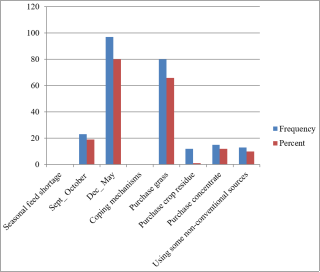
The specific feed shortage, the duration of the shortage, and the coping strategies employed are illustrated in Figure 1. Approximately 96% of the households surveyed reported experiencing feed shortages. The majority of farmers (80%) encountered this issue during the dry season, which lasts from December to May, and they indicated that they utilize various coping strategies to mitigate the feed shortage problem. The most common strategies adopted in the study area include purchasing grass and concentrates, as well as feeding non-traditional feed resources such as kitchen waste and enset leaves, which aligns with findings from several highland regions in Ethiopia .
The issue of feed shortages encountered during dry seasons in the study area was associated with moisture stress, which led to reduced herbage growth on the current grazing lands. This finding is consistent with reports from various regions in Ethiopia that share a similar agro-ecological context. During the dry season, grasses are purchased as the primary source of roughage , although these grasses have a low nutrient content .
Figure 1. Feed shortage problems and coping strategy% of respondent (N=135).
3.6. Livestock Feed Sources
The major feed resources used for cattle in the area are indicated in Table 5. Among major feed sources identified, grazing, crop residue and desho grass were given 1st, 2nd and 3rd rank in the study area respectively.
Table 5. Major cattle feed sources in the district (N=135).

Feed type

Primary choice

Rank

1st

2nd

3rd

4th

T-sum

PI

Local grass (harvested)

25

34

39

33

131

26

1

Desho grass

20

21

54

32

127

25

2

Grazing

55

10

25

15

105

20

3

Crop residue

30

18

12

23

83

16

4

Elephant grass

5

`12

23

0

28

5

5

Concentrate

10

0

0

10

20

3

6

Enset leaf

5

2

21

2

9

1

7

The findings concerning feed resources indicate that grazing, crop residues, and local grasses are the primary sources in the region, which aligns with observations from the Anelemo district of the Hadiya zone . The use of concentrated feed in the area was notably high during the dry season, aimed at complementing the low-quality roughages that are available during this time. Due to the limited grazing land that has led to a reduced stocking rate of animals, most farming families engage in daytime controlled or tethered grazing and provide individual feeding at night.
3.7. Seasonal Livestock Feed Availability and Utilization
The availability of feed resources and their seasonal use are detailed in Table 6. In the study areas, the primary feed resources included Crop residues, Grazing, Elephant grass, and Desho grass. Specifically, during the dry seasons, the main feeds commonly used were Crop residues, Grazing aftermath, Elephant grass, Local grass, and Desho grass. Conversely, in wet seasons, the feed resources that were mostly utilized included Grazing on pasture, Elephant grass, Local grass (through a cut and carry system), and Desho grass. Improved forages were generally used as a supplement throughout both the dry and wet seasons.
Table 6. Seasonal availability and utilization of feed resources (N=135).

Dry season

Wet season

Feed resources

Primary choice

Rank 2nd

Feed resources

Primary choice 4th

Ran

1st

2nd

3rd

4th

1st

2nd

3rd

4th

Crop residue

68

3

3

0

133

1

Grazing on pasture

111

12

9

0

132

1

Desho grass

30

13

32

32

107

4

Desho grass

78

4

5

8

95

4

Elephant grass

25

20

49

30

124

3

Elephant gras

12

40

46

9

107

3

Grazing

47

40

43

2

132

2

Crop residue

23

45

55

0

123

2

Source: Field Survey, (2021)
3.8. Livestock Feeding Practice
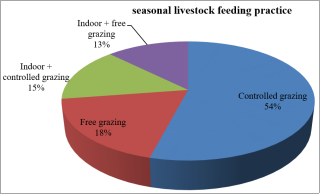
Seasonal animal feeding practices observed are presented in Figure 2. The majority of farmers engaged in individual feeding at night and managed grazing during the day. Free grazing was the most prevalent feeding practice in the research area.
Figure 2. Seasonal livestock feeding practice.
Majority of the householders of the study area have experience using various supplementary feeds such as Atela (by-products from local brewing), wheat bran, and additional items (food grains, enset corm, food scraps, root crop tubers, and sweet potato vine).
3.9. Improved Forage Production
The primary improved forage cultivated in the region is shown in Table 7. Nearly all householders in the study area (100%) have knowledge in producing improved forage, particularly elephant grass and desho, which are the most prevalent in the region. Satariya and Guatemala grass are new forage varieties that have been recently introduced.
Table 7. Improved forage producers and forage type produced in three kebele (N=135).

Description

Frequency

Percent

Use of improved forage

Forage type /ha/

Hectare

% of respondents

Desho grass/ha/

380

79

Elephant grass/ha/

76.85

16

Satariya

14.25

2.9

Guatemala grass/ha/

7,125

1.4

Improved forage production is thought to be a solution for addressing feed shortages, yet it faces several hurdles such as small land holdings, competition from food crop cultivation, insufficient availability of forage seeds, and a lack of knowledge regarding forage species and their production methods. This issue has been worsened by the lack of a system for supplying and distributing improved forage seeds in the region. In contrast to this finding, land was identified as the main constraint in the Anelemo and Robi districts .
3.10. Constraints for Improved Forage Production
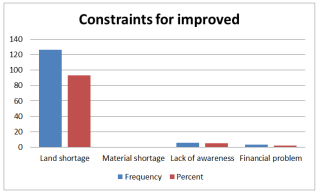
Major constraints that hampered improved forage productions are presented on Figure 3. Majority of the householders responded that they have shortage of Land and Financial problem as primary constraints followed by lack of awareness; with shortage of land were highly prominent (93%) in the study areas.
Figure 3. Major constraints for improved forage production in the area (N=135).
Lack of awareness about various improved forages and their production method, along with limited land availability and access to improved forage seeds, has obstructed the advancement of improved forage technologies. Therefore, this scenario highlights the need for implementing diverse forage development tactics and the incorporation of legume forages that can be combined with other cropping systems.
4. Conclusion
The major feed resources in the area were natural pasture which is shrinking from time to time as a result of converting lands to food crop production. Besides, the quality of available feed from pasture land is not substantial to livestock need, because its quality and quantity was highly fluctuated to the season of the year. Hence feed shortage was recorded as primary constraints in the study area following seasonal fluctuation. Accordingly, feed shortage season started from end of December to May. The observed feed shortage was exacerbated by lack of supplementary feed like improved forage production in the area. As a result, purchased feeds and several locally available by products like enset leaf were used as a coping mechanism against feed shortage. Though it was not at adequate level, these were starting points for improved forage adoption in the area. So introducing of improved forage like desho grass, vetch, elephant grass, sesbania, and lecuceana were becoming as common practice in the study area. Farmers gave particular emphasis to lactating cows, pregnant cows, fattening cattle and calves in utilizing this improved forage. Shortage of land, lack of awareness and the increased piece of forage seed were the main constraints that hinder the adoption of improved forage.
Abbreviations

DA

Development Agents

SNNPR

South Nation National People Region State

SPSS

Statistical Package for Social Science

Acknowledgments
First of all, I would like to express my sincere gratitude to wolkite University for financial and overall supports for my whole works. I am also grateful to Mr. Mebrate Gebresilasie for his valuable support during data collection. Lastly, I would also like to extend my appreciation to all my friends from Department of Animal Science who have been supportive throughout and provided a stimulating environment for my work.
Author Contributions
Kedir Adem is the sole author. The author read and approved the final manuscript.
Conflicts of Interest
The author declares no conflicts of Interest.
References
[1] (Central Statistical Authority) (2020). Agricultural sample survey. 338, Volume IV, CSA, Addis Ababa. Pp.
[2] Hurissa, B. and Legesse, G. (2008) Livestock marketing in Ethiopia: Development opportunities and constraints. A paper presented on a Workshop Organized by Ministry of Federal Affairs and Afar Regional State. August 3-4, 2008, pp. 9-12.
[3] Mengistu, A. (2003): The genetic resources perspective of equines in Ethiopia and their contribution to the rural livelihoods. Proceedings of the 11th Annual Conference of the Ethiopian Society of Animal Production (ESAP). Addis Ababa, Ethiopia: 81-85.
[4] CSA. 2011. Agricultural sample survey 2010/11. Volume II report on livestock and livestock characteristics (private peasant holdings). Central Statistical Agency (CSA): Addis Ababa, Ethiopia.
[5] Berhanu, G., Jaleta, M., and Hoekstra, D. (2009). Smallholders, institutional services, and commercial transformation in Ethiopia. Agric. Econ. 40, 773–787.
[6] Biruk, S., Yilma, T., Andualem, M. and Tilahun, B. (2014) Health Professionals’ Readiness to Implement Electronic Medical Record System at Three Hospitals in Ethiopia: A Cross Sectional Study. BMC Medical Informatics and Decision Making, 14, 115.
[7] Salo S, Tadesse G, Haylemeskel D. Survey on constraints of improved forage adoption in Anelemo Woreda, Hadiya Zone, Ethiopia. Agri Cultural Research and Technology: Open Access Journal. 2017; 12(2).
[8] Abba B. 2010. Livelihood strategies of small holders with particular focus on model farmers: the case of lemo woreda, Hadiya zone, SNNPR, Africa, p. 90.
[9] Yadessa, E. 2015. Assessment of feed resources and determination of mineral status of livestock feed in Meta Robi District, West Shewa zone, Oromia Regional State, Ethiopia. MSc thesis in Animal Production. Ambo, Ethiopia: Ambo University.
[10] Mekonnen, Z., Worku, A., Yohannes, T., Alebachew, M., Teketay, D., & Kassa, H. (2014). Bamboo Resources in Ethiopia: Their value chain and contribution to livelihoods. Ethnobotany Research and Applications, 12, 511–524. Retrieved from
[11] Yenesew Abebe; Solomon Melaku; Azage Tegegne; Firew Tegegne, 2013. Assessment of sheep production system in Burie district, north western Ethiopia. Glob. J. Agric. Res., 1(2): 29-47.
[12] Adem, K. (2024). Feed Resources for Livestock and Improved Forage Production Status in Enor Woreda, Gurage Zone of Ethiopia. American Journal of Life Sciences, 12(6), 104-112.
[13] K. Gurmessa, T. Tolemariam, A. Tolera, F. Beyene, S. Demeke, Feed resources and livestock production situation in the highland and mid altitude areas of Horroand Guduru Districts of Oromia Regional State, Western Ethiopia, Sci. Technol. Arts Res. J. 4(3) (2015) 111–116.
[14] Getahun, L. (2008) Productive and Economic Performance of Small Ruminant Production in Production System of the Highlands of Ethiopia. PhD Thesis, University of Hohenheim, Stuttgart-Hoheinheim.
[15] Mekasha A, Tesfaye K and Duncan AJ. Trends in daily observed temperature and precipitation extremes over three Ethiopian eco-environments. International journal of climatology. 2014; 34.
[16] Deribe, G. 2015. Evaluation of major feed resources in crop-livestock mixed farming systems, southern Ethiopia: Indigenous knowledge versus laboratory analysis results. Journal of Agriculture and Rural Development in the Tropics and Subtropics. Vol. 116 No. 2(2015) 157–166.
Cite This Article
  • APA Style

    Adem, K. (2025). Improved Forage as Supplemental Feed Source and Its Utilization System in Yem Special Woreda of Central Ethiopia. International Journal of Statistical Distributions and Applications, 11(2), 20-27. https://doi.org/10.11648/j.ijsda.20251102.11

    Copy | Download

    ACS Style

    Adem, K. Improved Forage as Supplemental Feed Source and Its Utilization System in Yem Special Woreda of Central Ethiopia. Int. J. Stat. Distrib. Appl. 2025, 11(2), 20-27. doi: 10.11648/j.ijsda.20251102.11

    Copy | Download

    AMA Style

    Adem K. Improved Forage as Supplemental Feed Source and Its Utilization System in Yem Special Woreda of Central Ethiopia. Int J Stat Distrib Appl. 2025;11(2):20-27. doi: 10.11648/j.ijsda.20251102.11

    Copy | Download

  • @article{10.11648/j.ijsda.20251102.11,
      author = {Kedir Adem},
      title = {Improved Forage as Supplemental Feed Source and Its Utilization System in Yem Special Woreda of Central Ethiopia
    },
      journal = {International Journal of Statistical Distributions and Applications},
      volume = {11},
      number = {2},
      pages = {20-27},
      doi = {10.11648/j.ijsda.20251102.11},
      url = {https://doi.org/10.11648/j.ijsda.20251102.11},
      eprint = {https://article.sciencepublishinggroup.com/pdf/10.11648.j.ijsda.20251102.11},
      abstract = {This study was conducted to assess the improved forage production and Utilization. For this study, three kebeles were selected purposively based on their livestock potential and 160 households were selected from selected kebeles randomly. The major feed resource in the study area was crop residue and pasture land grazing. The dominant forage species adopted in the area were Desho and elephant grass. Primary problem for livestock production was the shortage of feed resources. Majority (66%) of the households were in the active productive age (31-45) about 60% of household heads were literate (primary school and above). The average land cultivated per household in the study area was 0.25 hectares. Crop production was the principal source of cash income in the region, followed by cattle production in second place and sheep production in third. Almost all households in the study area had experience in cultivating improved forage, particularly elephant and desho grasses. The main challenges related to livestock production identified in the area were primarily diseases, ranked first, followed by feed shortages in second place, and water shortages in third, along with issues related to poor breed performance to some extent. Among the main feed sources identified, grazing, crop residues, and desho grass were ranked first, second, and third, respectively, in the study area.
    },
     year = {2025}
    }
    

    Copy | Download

  • TY  - JOUR
    T1  - Improved Forage as Supplemental Feed Source and Its Utilization System in Yem Special Woreda of Central Ethiopia
    
    AU  - Kedir Adem
    Y1  - 2025/04/29
    PY  - 2025
    N1  - https://doi.org/10.11648/j.ijsda.20251102.11
    DO  - 10.11648/j.ijsda.20251102.11
    T2  - International Journal of Statistical Distributions and Applications
    JF  - International Journal of Statistical Distributions and Applications
    JO  - International Journal of Statistical Distributions and Applications
    SP  - 20
    EP  - 27
    PB  - Science Publishing Group
    SN  - 2472-3509
    UR  - https://doi.org/10.11648/j.ijsda.20251102.11
    AB  - This study was conducted to assess the improved forage production and Utilization. For this study, three kebeles were selected purposively based on their livestock potential and 160 households were selected from selected kebeles randomly. The major feed resource in the study area was crop residue and pasture land grazing. The dominant forage species adopted in the area were Desho and elephant grass. Primary problem for livestock production was the shortage of feed resources. Majority (66%) of the households were in the active productive age (31-45) about 60% of household heads were literate (primary school and above). The average land cultivated per household in the study area was 0.25 hectares. Crop production was the principal source of cash income in the region, followed by cattle production in second place and sheep production in third. Almost all households in the study area had experience in cultivating improved forage, particularly elephant and desho grasses. The main challenges related to livestock production identified in the area were primarily diseases, ranked first, followed by feed shortages in second place, and water shortages in third, along with issues related to poor breed performance to some extent. Among the main feed sources identified, grazing, crop residues, and desho grass were ranked first, second, and third, respectively, in the study area.
    
    VL  - 11
    IS  - 2
    ER  - 

    Copy | Download

Author Information
  • Abstract
  • Keywords
  • Document Sections

    1. 1. Introduction
    2. 2. Material and Methods
    3. 3. Results and Discussion
    4. 4. Conclusion
    Show Full Outline
  • Abbreviations
  • Acknowledgments
  • Author Contributions
  • Conflicts of Interest
  • References
  • Cite This Article
  • Author Information